Terrorism and Criminal Organisation Accusations
The claim that he supports terrorism or regards it as legitimate
Unfounded
Claim
Fact
This claim went into circulation after the dawn operation of 30 January 2018 and was repeated throughout the terrorism case file, which lasted until his release on 5 December 2019. Its answer stands, before any document, in Kuytul's own sentences.
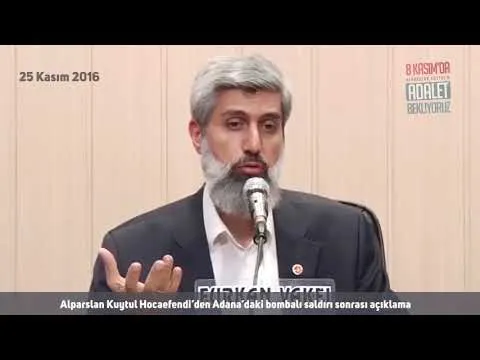
On 25 November 2016 a bomb attack was carried out on the governor's office building in Adana. After the attack Kuytul said the following:
"We are obliged to condemn attacks of this kind. There can be no such struggle. I do not know who did this, but what they did is not permissible."
"Rights are not sought by killing innocent people. Rights are not sought by killing soldiers and police officers."
In the same statement he put a question to the person who set off the bomb: if their own mother, father or child had been there, would they have pressed that button? What comes next is his sentence too — "Is someone else's life an aubergine? Everyone has a life."
The path he proposed for the guns to fall silent is plain to see as well: that the sides accept the Qur'an and the Sunnah as arbiter, that a committee formed of impartial scholars declare the ruling, and that both the state and the organisation give their word to abide by that ruling.
His only known connection with ISIS, on the other hand, runs in the opposite direction: because he criticised the organisation he received threats many times, his name appeared on the death list in the magazine ISIS published on the internet, and members of the police asked him whether he wanted protection.
This claim was voiced again on 7 September 2026 on the CNN Türk programme "Tarafsız Bölge". The collected answer to the imputations listed on the programme: Cübbeli Ahmet's claims about the Furkan Movement on CNN Türk — the Furkan Movement's statement in full.
When did the claim appear?
On the morning of 30 January 2018 a simultaneous operation was carried out against Alparslan Kuytul's home and the building of the Furkan Foundation, and 24 people, Kuytul among them, were taken into custody. On 8 February 2018 he was arrested and sent to Bolu F-Type Prison. Immediately after the operation some channels and news sites linked him at one and the same time to four separate terrorist organisations that were enemies of one another.
These four organisations were fighting one another in the field. That all four should be attributed to the same person at the same moment explains on its own how the claim was built: the conclusion was written first, and the evidence was looked for afterwards.
What has he been saying about terrorism for years?
Kuytul's stance on terrorism is not a defence that took shape after the operation; it is a view he has repeated for years in his talks and in answer to the questions put to him. Its clearest example is the statement he made after the bomb attack on the governor's office building in Adana on 25 November 2016:
"I have said it many times: acts of this kind cannot be permissible. Whoever does it, if they say I am doing this to seek my rights, rights are not sought like this."
"Rights are not sought by killing innocent people. Rights are not sought by killing soldiers and police officers."
At the end of the statement he prayed for mercy for those who died in that attack and in others like it, and offered condolences to their families.
So what is the solution?
The sincerity of a view is measured by looking at what it puts in place of the thing it opposes. Kuytul's proposal is that arbitration, not the weapon, be put on the table:
"Let a committee formed of impartial scholars declare the ruling of God and His Messenger. Let both the state and the organisation give their word that they will accept it."
This proposal was made in response to the clashes that increased after the end of the resolution process, and it calls on the sides to give up arms.
The name on the death list of ISIS
Kuytul's assessment of ISIS also goes back years: he has explained that structures of this kind produce division within the ummah, that sincere young people are drawn into conflict zones and destroyed there, and that the takfirist understanding harms Muslims. The result is this:
- He has received threats from the organisation many times.
- Members of the police asked him whether he wanted protection.
- His name appeared on the death list in the magazine ISIS published on the internet.
So there is indeed a connection; but the side doing the targeting is the organisation. What is more, there is an ISIS member who said in their police statement that they had come to Adana in order to assassinate Kuytul — some publications tried to present this person as a student of Kuytul's. A person cannot be both the target of the same organisation and its man; it is here above all that one sees the claim was built on a headline rather than on a document.
What happened in the indictment?
The first accusation was membership of a terrorist organisation. While preparing the actual indictment, the prosecutor withdrew the membership accusations; what remained was only the accusation of making propaganda for a terrorist organisation. Kuytul assessed this from prison as follows:
"Why would a person make propaganda for a terrorist organisation without being a member of it? Even those who belong to them cannot make propaganda, out of fear. If someone who does belong to them will not take that risk, why would someone who does not belong to them make propaganda for them?"
The withdrawal of the membership accusation shows that the claim could not stand up within its own terms either.
The same sentence while in detention
How genuine a view is can be understood by looking at whether it changes while the price for it is being paid. In the letter he wrote from Bolu F-Type Prison in April 2019, which was made public, Kuytul set down the same sentence:
"Whatever oppression they commit, whatever slander they cast, we will go on explaining the diamond-like truths of the Qur'an and the cause of tawhid until we die. We have never been involved in terrorism, and God willing we will not be involved in it after this either."
The statement condemning terrorism was made in 2016, more than a year before his arrest; the letter, on the other hand, was written after fourteen months in prison. In between, the stance did not change — a view produced once the need for a defence arises does not behave like this.
All the dates on this page belong to the process opened by the operation of 30 January 2018. The subject of the second case file opened in the same period is not terrorism but the claim of founding a criminal organisation.