The claim that "he took his place alongside the Boğaziçi protesters"
Partly true
Claim
Fact
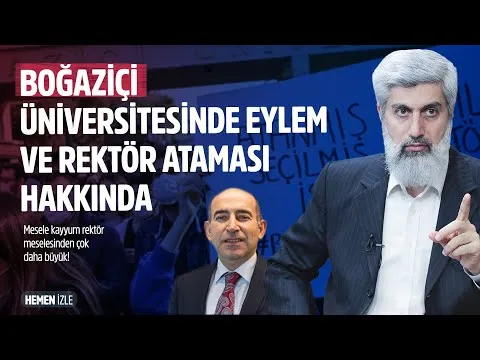
January 2021. After a rector was appointed to Boğaziçi University by the President, the students began a protest. On the "Gündeme İslami Bakış" programme of 9 January 2021, Alparslan Kuytul assessed the matter in response to a question put to him.
We are not hiding the part of the claim that is true: Kuytul openly objected to the appointment, regarded the protest as legitimate and called on the rector Melih Bulu to resign, telling him "Do not go down in history as a trustee rector; go down in history as a hero rector".
But that is not what the claim says. The claim says that he took his place alongside the protesters, that is, that he adopted their views. Kuytul's criterion is the exact opposite. On the programme of 6 February 2021 he explained himself what he had meant:
"If there is a protest, whoever supports it may take part in it, whatever view they hold."
"If a protest is legitimate it is legitimate; if it is not, then it is not anyway."
In other words, whether a protest is justified is determined not by the identity of those who take part but by its subject. Whoever takes part, this criterion does not change.
Why is this label "Partly true"?
This is the part that is true: Kuytul really did find this protest justified, he criticised the appointment and he called on the rector to resign. We do not deny it; what he said is on record.
But this is not a fault. Objecting to an appointment being made to a post that ought to be determined by election is a political view, and it was defended openly together with its reasons; nothing is being concealed. Secondly, finding a protest justified does not mean adopting the worldview of those who take part in it. This is exactly where the claim goes wrong: it relays a view about a subject as though it were approval of a crowd.
What exactly did he say on 9 January 2021?
The written statement of the Furkan volunteers dated 6 February 2021 relays what was said on that programme point by point. What was said falls under four headings:
- An objection to rectorships, which ought to be determined by election, being placed under trustees by way of appointment, as had previously been seen at foundations and municipalities.
- The view that this practice is connected with the country moving in a direction in which elections and courts lose their function.
- The observation that the photograph showing the gate of the university in chains will go down in history, and a warning about the increase in police harshness.
- The call on the rector Melih Bulu to resign.
None of this was concealed, softened afterwards or denied. The recording is there for all to see, and the same view has been defended for years on the same grounds.
By what is the legitimacy of a protest measured?
The whole weight of the claim rests here. Judging a protest by looking at who took part in it produces a rule whose consequences apply to everyone: if a group you dislike joins a demonstration, that demonstration is deemed illegitimate whatever its subject may be.
Kuytul's criterion looks instead at the subject of the protest. On the programme of 6 February 2021 he summed it up as follows: whoever has taken part has taken part, and the participation of some people does not defile the protest; if a protest is legitimate it is legitimate, and if it is not, then it is not anyway.
The difference between "supporting" and "taking one's place alongside"
The expression in the headline of the report was "he made his side clear". Such an expression presents a view about a subject as though it were a membership signed up to in a crowd. Yet people who voice the same demand may have completely different reasons for it, and that does not tie one of those demands to the other.
Indeed, what the same statement points to as the real issue is neither the identity of the protesters nor the administration of the university; it is the question of the direction in which the country's administrative structure is moving. The statement of the Furkan volunteers points to the same thing: that the issue is not atheism or LGBTI, and that pulling the debate there serves to close off the real subject.
What shows the distinction most clearly is whom the call was addressed to. Kuytul addressed not the protesters but the rector, and asked him to resign. Someone who takes their place alongside a crowd addresses the crowd; here what is addressed is an office.
Document
Why do we not say "Unfounded"?
We could have; the sentence "he did not support the protesters" could technically have been constructed, because what was supported was a demand and not a group. But that would have meant keeping something from the reader. Kuytul found that protest justified, he said so openly and he called on the rector to resign. Anyone who listens to the recording hears it.
To say "wholly unfounded" in such a place would make everything else this site says suspect as well. That is why the label is "Partly true": the part that is true is a political view defended openly together with its reasons — not a failing to be concealed. The part that is false is the relaying of that view as though it were approval given to a whole crowd.
Other claims derived from the same statement: "LGBT supporter" · "he showed tolerance towards those who insulted the Kaaba"