Claims About the Coronavirus and the Prayer Bans
The "He Does Not Know the Plague Hadith" Claim
Unfounded
Claim
Fact
The claim arose during the Friday prayer debate in the spring of 2020. While Kuytul was arguing that congregational prayer could be performed if precautions were taken, the question put to him was this: do you not know the plague hadith about epidemic disease?
The answer is short: he explained that hadith himself in his own talks. A hadith he had expounded years earlier was later presented as evidence of ignorance against him. The question itself is also selective: the same hadith was not being brought up for bank queues, for shopping centres or for minibuses; it came into play only when a request concerning worship was raised.
The ruling of the hadith is clear: one does not enter a place where there is an epidemic, and if one is in a place where there is an epidemic, one does not leave it. That is, it prevents the illness from being carried between cities. Kuytul has never advised anyone to change city, and has never said "leave the place you are in" or "take in people from outside". There is no point of contact between what he said and what the hadith forbids.
The second hadith often cited alongside it — that the sick should not be brought near the healthy — commands distance. Kuytul has no objection to distance; on the contrary, he argued that congregational prayer could be performed while keeping distance. In his own words: "Did I oppose keeping a distance? We can keep a distance."
The summary of the matter lies in a single sentence of his own:
"Tell me to take precautions! But do not stand in the way of my congregational prayer."
Where did the question come from?
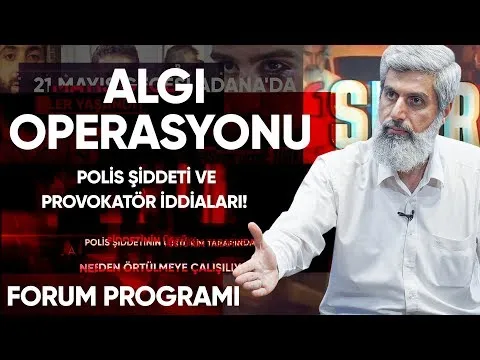
When the mosques were closed and Friday prayer was suspended in the spring of 2020, a frequently used answer emerged against those who objected to that decision: "do you not know the plague hadith?" The sentence was framed as a piece of evidence; its function, however, was to end the discussion. The same question was put to Kuytul as well, in the forum programme of 29 May 2020.
The striking thing about the question is this: the same circles were not bringing up the same hadith for the queue in front of the bank, for the shopping centre, for the market place or for the minibus. The hadith came into play only when a request concerning worship was raised.
What does the hadith say?
The ruling of the hadith has two sides: one does not enter a place where there is an epidemic; and if a person is already there, they do not leave it. The reason for the second prohibition is clear — to prevent the illness from being carried to another city. The hadith is therefore a quarantine ruling, not a ruling about worship.
Where does Kuytul stand in this?
Nowhere in it. He advised no one to change city, he did not say "leave the place you are in", he did not say "take in people from outside". He has defended neither of the two behaviours the hadith forbids. In his own words:
"In the hadith: do not enter a place where there is a plague epidemic, and if you are there, do not leave. Now, did I say: if you are there, leave and go to another city?"
Moreover, he is not someone who heard the hadith for the first time in that debate; he explained it in his own talks. To ask someone who gave a talk on a subject years earlier whether they know that subject weakens the claim itself.
The second hadith: distance
The other hadith often cited in the debate says that the sick should not be brought near the healthy. The conclusion Kuytul draws from it is the same as the one drawn by the person making the claim: keep your distance.
Does this, then, abolish congregational prayer? It does not. Congregational prayer can also be performed while keeping distance — and indeed, when the mosques were opened on 29 May 2020, that is exactly how it was performed: with masks, one metre apart, with temperature checks and disinfection at the entrance. This was also what Kuytul had been saying for months. It is not possible to refute a person who has no objection to distance with a hadith that commands distance.
The scope of the hadith was also being overlooked. The hadith regulates contact between the sick and the healthy; not healthy people standing in the same row while keeping their distance. When this distinction was not made, the hadith was turned into the justification for a prohibition far beyond its own ruling.
What was the actual debate?
The accusation pressed by way of the hadith was covering up the real debate. Kuytul's question was not about the existence of the epidemic or the necessity of precautions. His question was this: when praying alone at the same distance is permitted, by what medical justification is it explained that the prohibition begins once one person steps forward and becomes the imam?
This question cannot be answered with the plague hadith, because the hadith commands distance; it has nothing to say to a congregation that keeps its distance. Kuytul's position comes together in a single sentence: whatever the experts say is accepted — masks, distance, handwashing, all of it. The only thing he wanted was that the measures taken should not be widened so far as to decide the form of worship.
Why "unfounded"
Because for the claim to hold, one of two things would have to be true: either Kuytul would not know the hadith, or he would be defending something the hadith forbids. The recording of the talk removes the first, and the whole body of his statements removes the second. What remains is not a gap in knowledge, but an attempt to close down a debate.
Content that forms the continuation of this topic: the "He opposed the coronavirus measures" claim.