Cropped Videos and Distorted Statements
Was the Phrase "His Pen Has Been Broken" an Insult to the President?
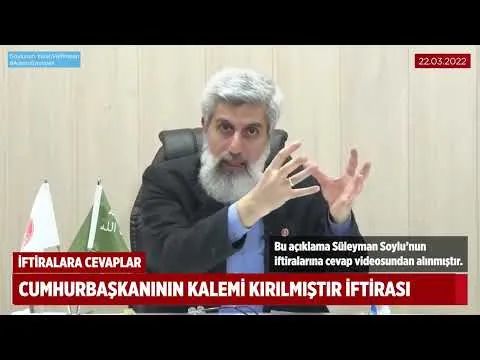
Unfounded
Claim
Fact
This claim rests on a speech of 1 July 2016. The speech became the subject of a case brought on a charge of "insulting the President"; the case ended in acquittal on 10 January 2019, while Kuytul was in detention following the operation of 30 January 2018 and his arrest on 8 February 2018.
The excerpt put into circulation was a single sentence: "Tayyip Erdoğan's pen has been broken." With what comes before and after cut away, the sentence looks like a wish. But it is not a wish; it is a description — of what others are doing:
"From here I want to warn both the President and the AK Party about this matter. They are taking away every bit of the honour they have gained... What this means is: Tayyip Erdoğan's pen has been broken. So that nobody will pity him when he is finished off, so that none of those who love him are left, the honours he has gained must be taken back... If they listen to me it is for their own good; if they do not, that is their affair."
The subject of the sentence is not the speaker but "they". The pen that has been broken was broken by that "they". The role Kuytul reserves for himself is only that of giving notice — and indeed his words end where a warning ends, not an insult: if they listen, it is for their own good.
Two official bodies reached the same conclusion. The chief inspector of the Directorate General of Foundations, who examined the complaint, found the speech "to be of a cautionary nature, to the effect that precautions should be taken in advance", and wrote into his report the opinion that it "was not of a malicious or insulting nature". The court, too, returned an acquittal on 10 January 2019.
For the second claim built on the same speech: the claim that "he knew about the coup in advance" and the altered date.
When was the speech made, and in answer to what question?
On 1 July 2016 Kuytul was asked where Turkey was heading. In his answer he set side by side several events everyone was following in the news at the time: the President of the United States not wanting to meet the President, the treatment shown to the President at Muhammad Ali's funeral, and the seating arrangement outside protocol in which the President was placed during the visit to Uganda.
The conclusion he drew was this: certain powers have decided to finish the government off, and to that end they are first taking back its standing. This was not intelligence but a reading anyone who reads a newspaper could make — and it was said as a warning.
Who is breaking the pen?
The whole weight of the claim rests on a single point of grammar: who is the subject of the sentence?
In the excerpt the subject is invisible, because the part that carries it has been cut away. In the full recording the subject is plain: the one breaking the pen is "they", that is, the foreign powers Kuytul is describing. "His pen has been broken" is not a decision but a diagnosis; the part that follows — "so that nobody will pity him when he is finished off..." — says the same thing.
For a sentence to count as an insult it must be directed at the person addressed. The sentence here points not at the person addressed but at those ranged against him. Kuytul's own position is written at the end of the sentence: if what he says is heeded, the party that benefits is the one addressed.
What did the state's own inspector write?
The complaints made to BİMER over the clipped recording went to the body charged with supervising foundations — the Directorate General of Foundations. The chief inspector appointed to the case examined not the excerpt circulating on social media but the full recording on the foundation's own site, and in his report first established the situation itself: that only the "his pen has been broken" portion of the recording had been brought to the fore, that this portion had also been published on its own, and that for this reason a great many people had felt the same disquiet and lodged complaints.
He then wrote his assessment:
... Alparslan Kuytul delivered a speech of a cautionary nature, to the effect that President Recep Tayyip Erdoğan should take precautions in advance in certain matters ... the opinion having formed that the speech was not of a malicious or insulting nature ...
Report of the chief inspector of the Directorate General of Foundations
The weight of this assessment lies in where it came from. There is no statement here made by the foundation about itself; a state inspector charged with examining the complaint watched the recording and found no insult.
The court
The case for insulting the President brought over the same words was heard on 10 January 2019 and ended in acquittal. When the decision came, Kuytul had been in detention since 8 February 2018 — that is, for eleven months.
Why was the acquittal not heard about?
Not one of the media organisations that reported the clipped recording announced the acquittal with the same prominence. The life of a claim in society ends not when it is disproved but when its disproof is made known; that is the reason these pages exist.
Throughout the process no media organisation asked the man who said the words what he had meant by them. Yet the answer was there without being asked: the full recording was standing on the foundation's own site.
The second claim produced from the same speech — "he knew about the coup in advance" — rests on a change of date and was never even made the subject of a case at the prosecution stage. On the method itself: Cutting a sentence off in the middle.