Claims About the Coronavirus and the Prayer Bans
The "They Attacked the Police" Claim
Unfounded
Claim
Fact
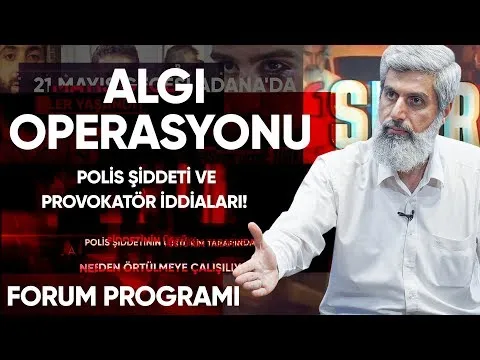
The night of 21 May 2020, Adana. There was an intervention against a small group that wanted to perform the prayer in the open air around the Merkez Mosque and the Merkez Park beside it; over the course of the night the number of people taken into custody reached 47. The following day the incident was announced in some reports as "when the police did not allow it, they attacked the police".
What there is on record is a violence that runs in one direction only. Those taken into custody obtained a medical report on the beating from forensic medicine and from the hospital; the wounds of some of them were found to be too grave for a general practitioner to certify, and they were referred to a specialist doctor. On the other side there is no document to match this.
The footage points the same way: kicks to the face of people lying on the ground handcuffed behind the back, blows to the head with a helmet, pepper gas into the mouth and the eyes from close range. Kuytul's question is a simple one:
"Had you struck the police even once, then presumably one police officer's mouth and nose would have been broken too, would they not?"
Two details that went on record also show how the claim was produced. Those who lived through the incident have recounted that, while the beating was going on, those carrying out the intervention shouted that the police were being hit; and that once the beating was over, a camera was turned on inside the vehicle and those in custody were asked to shout. Both are words spoken in order to go onto an audio recording.
How did the incident begin?
On the night of 21 May 2020 five or six people took their prayer mats and went to Merkez Park in Adana to perform the isha and tarawih prayers. The police said that the prayer could not be performed here and that there was a ban by the governor's office. When the group asked to see the written decision of the ban, they were told that the paper would not be shown and that the officer had imposed the ban himself. No one entered the park.
The point common to the accounts of those who lived through it is this: the intervention took place not inside the park but as they were moving away from there. Some were beaten while walking to their cars, some while crossing to the other pavement, and some while coming to ask what had happened after hearing of the incident afterwards. Those in this last group were not even among the group that had prayed.
The documents are all on one side
Those taken into custody were referred to forensic medicine and from there to the hospital, and obtained their medical reports on the beating. Part of what they recount are injuries that appear in the reports: a boot kick to the eye and an eye that swelled within hours, a blow to the head with a helmet, being stepped on the neck and the head after being handcuffed behind the back, pepper gas into the mouth and the eyes from close range, an arm on the point of being broken. There are three sources that confirm this picture: the reports, the footage that could be taken that night, and witnesses who speak under their own names.
Against the claim that "they attacked the police", on the other hand, there stands only a news headline.
Why is a forensic medical report not taken in a police building?
According to what Kuytul recounted at the forum dated 29 May 2020, an article that appeared in a newspaper related that the Adana police had called the forensic medicine doctor in to write the reports in the police building, and that the doctor had found this contrary to procedure and had not accepted. Kuytul draws attention to the importance of this detail: a report written in the police building, under the supervision of the police, counts as having been obtained under pressure and becomes invalid. Those in custody were for this reason taken to forensic medicine in groups; this is the reason the reports are in hand today.
With the camera on and with the camera off
The two methods described by those who lived through the incident explain how the claim was born.
- While the beating is going on, those carrying out the intervention say out loud that the police are being hit; the words go onto the recording devices at the scene in that form.
- Once the beating inside the vehicle is over, an officer turns the camera on and asks those in custody to shout. The camera records only what comes afterwards.
Kuytul also recounts that in an earlier incident a police superintendent leaned towards the ear of someone in custody and swore at him heavily, then drew back as though nothing had happened and waited for a response: the camera filming from a distance will see only the response.
"His swearing is not heard, but yours will be heard; that is the tactic."
Can a complaint be made?
Those who were beaten made a complaint. But in Turkey, before an investigation can be opened into a police officer, the governor must first give permission; if the governor does not give permission, the prosecutor's office does not look at the file. Kuytul's objection here is a legal question independent of the incident: when the same act is committed by another citizen one can go directly to the prosecutor's office, so why, when a law enforcement officer is concerned, is an administrative permission required?
What is left?
On one side the reports, the footage and the testimonies; on the other only a single sentence. That is the reason the label is "Unfounded".
The full account of that night, in the words of those who lived through it, is on the the testimony of those who were beaten page. The other two claims about the same night: The "They Prayed with Zero Distance Between Them" Claim and The "He Brought the People Out onto the Streets and Disturbed Public Order" Claim.