Claims About the Coronavirus and the Prayer Bans
The Claim That They Staged a Prayer Provocation in Adana
Unfounded
Claim
Fact
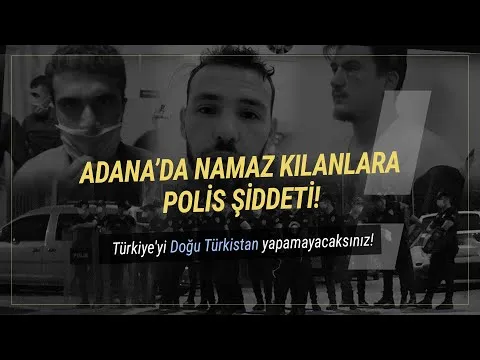
The events took place on the night of 21 May 2020 — the last week of Ramadan, in Merkez Park next to the Merkez Mosque in Adana. Everything described on this page belongs to that night and the following day.
Five or six people took their prayer mats and wanted to perform the isha and tarawih prayers in the park, wearing masks and leaving distance between them. The police had learned in advance what was going to happen and had closed the park, telling the group that they could not pray here. A decision of the governor's office was given as the grounds; when the written decision was asked for, it was not shown.
At that point the group began to disperse. There was not even an entry into the park. The beating began not in the park but on the pavement and on the road, while everyone was moving away from there. In Kuytul's words: "The incident does not happen in the park at all, it happens on the road. People have come out and are leaving, and they are being hit."
Over the course of the night the number of people taken into custody reached 47. Most of them had not taken part in the prayer at all; they were taken into custody because they had heard that a relative had been beaten and had come to the police station.
The claim comes down to a single question: who started the incident?
A provocation means deliberately starting an incident. The group that wanted to pray in the park listened to the police and left; no one threw a stone, no one attacked anyone. While the detentions went on until morning, not a single disturbance came from the crowd waiting in the street either. If a provocation is to be looked for here, its starting point is not the prayer but the intervention against people who were already moving away.
The order of that night
21 May 2020, the last week of Ramadan. Five or six people take their prayer mats and go to Merkez Park, next to the Merkez Mosque in Adana. The intention is to perform the isha and tarawih prayers leaving distance between them. The police have learned in advance what is going to happen and have closed the park.
Recep Kardaş, one of those who witnessed the first moment of the incident, describes the beginning as follows in the forum programme held on the night of 29 May 2020 and published two days later: they were told that they could not pray here; when the reason was asked, the ban of the governor's office was given as the grounds; and those who wanted to see the written decision were told that it would not be shown. The group did not insist, and began to disperse.
There was not even an entry into the park. No sit-in, no forcing of a gate, no slogans. Kadir Yılmaz, who spoke in the same programme, also says that he was asked to move away and that he crossed to the other side of the road. The intervention begins after this — not inside the park, but on the pavement and on the road.
Why is the number in custody 47?
Because most of those taken into custody have nothing to do with the prayer. First came the news that two people had been taken; the number became eight or ten; and then, together with the relatives who heard of the beating and came to the police station to ask what had happened, it rose to 47. One of those who spoke at the forum recounts that they were not even there at the time of the incident and had gone only to learn what the situation was. So the number shows not the size of the incident but how broadly custody was applied.
What a provocation is, and what it is not
A provocation is deliberately starting an incident in order to make the other side act. The points on which it can be tested are clear: the place of the act, its size, its first reaction and what follows it.
- Place: not in front of the police or the governor's office, but the edge of a park at night.
- Size: five or six people. In Kuytul's words, "it is shown as though hundreds of people had done it, there is no such thing."
- First reaction: leaving when the ban was stated. No resistance, no gathering of a crowd.
- What followed: while the detentions went on until nine in the morning, not a single disturbance came from the crowd waiting in the street.
Kuytul gathers into one sentence how the incident could have ended: "If they had not interfered with the prayer, this affair would have been over and done with. No one would even have heard of it."
The records that remain
- Reports of the beatings were obtained at the forensic medicine institute. Some were found to be of a severity that a general practitioner could not certify, and were referred to a specialist doctor.
- One of those taken into custody was given an administrative fine of 3,180 lira for contravening the Public Health Law, and a note of refusal to sign was entered in the record. This is the only official document that emerged at the end of the night; there is no charge of provocation or anything like it.
- Whether an investigation can be opened into the officers depends on the permission of the governor's office. Kuytul objects to this procedure with a single question: "Weren't we a state governed by the rule of law?"
There is also the record of the past
Praying in the open was not invented that night. It had been done before in Adana and in other cities, and in none of them did an incident arise. Kuytul turns this into a question: "When, up to today, have we ever staged a provocation?" The common element is not the prayer, but the intervention against the prayer.
In his own account he does not skip over the details he does not defend, either. He accepts that a group lined up to pray on the central median, and says "of course the central median is not really a suitable place for prayer". To defend an incident is not to find every detail of it right; this is the difference the claim skips over.
The detail of that night, in the words of those who lived through it, is on a separate page: the night of 21 May 2020 in the words of those who were beaten. The other claims arising from the same night: that Kuytul organised the incident, that an unauthorised tarawih prayer was held in the mosque, that they attacked the police and that they drove the people out into the streets.