Claims About the Coronavirus and the Prayer Bans
The Claim That He Opposed the Coronavirus Measures
Distorted
Claim
Fact
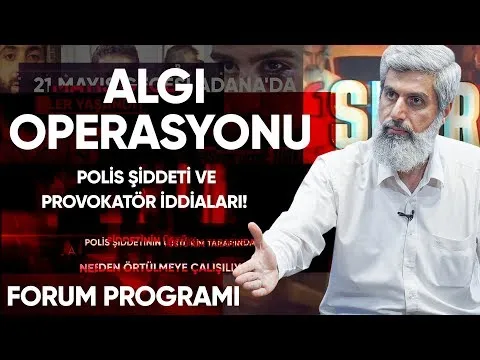
The period under discussion is March-May 2020. The mosques are closed, Friday prayer has been suspended, congregational prayer has been stopped. Alparslan Kuytul objected to these decisions; the objection was relayed to the public as "he is opposing the measures".
The sentence he framed is on record in the forum programme of 29 May 2020, and it consists of two halves:
"I am not entirely against the measures, but I am against their being exaggerated."
His attitude on masks, distance and cleanliness is plain as well: "Whatever the experts say, I accept... a mask, distance, washing my hands, taking a bath, whatever you say, let me do it." On the ban on the five daily prayers he said almost nothing at all; his reason was that those prayers can be performed at home in congregation with the family. Someone opposing the measures as a whole does not draw such distinctions.
The point he objected to was not the measure itself but a distinction that the measure could not explain: while praying alone at the same distance was permitted, the ban began the moment someone stepped forward and became the imam. The distance did not change, only a congregation was formed. In those same days shopping centres, open-air markets, queues at banks and minibuses running at half capacity were open.
Why this label, "Distorted"?
The side of the claim that is true: Kuytul really did find some of the measures taken exaggerated, he opposed the closing of the mosques and he said so loudly. We are not hiding it.
Why this is not a fault: "I find it exaggerated" and "I am against it" are not the same sentence. To debate the measure of a decision does not amount to hostility towards the aim of that decision. The distortion is made at exactly this point: an objection about proportion is relayed as a wholesale rejection.
Friday prayer was at the centre of the objection
Kuytul looked at the matter first from jurisprudence. The rule he relied on is this: if an obligatory act of worship can be carried out by taking a number of precautions, then taking those precautions and carrying out that obligation is itself obligatory; it may be given up only when there is no remedy at all. His finding was that a remedy existed.
The package he proposed was concrete: masks, one metre of distance, disinfectant and temperature checks at the entrance, everyone bringing their own prayer rug, the sunnah prayers performed at home, a very short sermon immediately after the call to prayer and the two obligatory rak'ahs. A Friday prayer set up in this way is over in ten minutes.
"I looked at the matter first of all not from the political side but from the scholarly and jurisprudential side."
Why did he stay silent about the five daily prayers?
This distinction alone breaks the picture of "hostility to the measures". In his own words he did not say very much about the five daily prayers, because those prayers can be performed at home in congregation with the family. Friday prayer, which requires a congregation, cannot be performed at home. He built his objection on precisely this difference.
A ban that distance cannot explain
The question he wanted answered was the soundest part of the objection. If three people pray separately one metre apart it is permitted; the moment one of them steps forward and becomes the imam it is banned. The distance is the same distance, the only thing that changes is that a congregation is formed.
In the same period shopping centres, open-air markets, queues at banks and cash machines and minibuses running at half capacity were open. He said that the gap between a seat in a minibus and the one in front of it did not reach half a metre, and that while this was permitted there was no ground for keeping closed a whole mosque in which three or five people were present at the daily prayers.
What did he rely on in saying "exaggeration"?
He did not base his assessment on a medical judgement of his own; he read the statements of some foreign groups of doctors and academics published in those days. He also drew his limit openly:
"I do not go into these parts, let the experts debate this part among themselves, I am saying what they say."
How much of those statements has been confirmed today is a separate debate and is not the subject of this page. The question here is this: did he oppose the measures? He did not present the views he relayed as his own expertise; on the contrary, he said again and again that the expertise was not his.
29 May 2020: when the ban was lifted
The mosques reopened on 29 May 2020 and Friday prayer was performed. That evening Kuytul asked: since the virus had not ended, why were the precautions deemed sufficient today not deemed sufficient for two and a half months? The same week, on 1 June 2020, the tourism sector was opening as well.
This is the form of a question that seeks the consistency of a measure, not of a question that opposes it. The difference between the two is where the claim disappears.
What is left
There are three sentences on the recording: that he was not entirely against the measures, that he accepted every measure the experts named, and that his objection was to congregational prayer being banned altogether. When only the third is taken and the first two are dropped, the sentence "he opposed the measures" comes out. That is why the label is "Distorted": the sentence relayed is there in the text, but half of the sentence is not.
There are two further headings often confused with this one: the calling of his finding the measures exaggerated a "conspiracy theory" — the claim that he did not take the epidemic seriously — and the accusation made through a hadith — the claim that he does not know the plague hadith.